5 Common Mistakes Beginner Surfers Make at UK Beach Breaks

Standing on a cold beach in Cornwall or Northumberland with a board under your arm, the sea looks straightforward: waves, foam, a bit of wind. Ninety seconds later you're sideways, salt in your sinuses, wondering what went wrong. Most beginner sessions at UK beach breaks don't fall apart because of fitness or courage. They fall apart in the ten minutes before you paddle out, and in the decisions you make once you're in the water.
British beach breaks are fussy. Sandbanks shift with every winter storm, the tide decides where a wave breaks and whether it breaks well at all, and the water is cold enough that your body won't give you much slack. These are the mistakes that come up again and again.
Beginners tend to park themselves in one of two places. Either too far inside, where every wave dumps whitewater on their head until their arms give out, or too far out the back, where the waves have already broken and reformed into soft lumps that won't carry them anywhere. Then there's the third version: drifting sideways through a busy pack, sitting right on the peak, getting in everybody's way.
The fix is simpler than it sounds. Pick a fixed landmark on the beach — a groyne, a lifeguard hut, a red-roofed building — and use it as a compass. Currents along UK beaches run hard, so glance at that landmark every couple of minutes and shuffle or walk back up the beach when you've drifted. Before you paddle out, watch a full set. Waves arrive in groups of three to five with a lull in between, and the peak, the steepest and highest part, usually stays in the same place, although it walks along the beach as the tide fills in. Sit just outside it, a metre or two towards the shoulder.
While you're there, learn the pecking order: the surfer closest to the peak has priority, so don't drop in. Paddle around the lineup, not straight through it. And never ditch your board when a set looms, because a loose board in a crowd is the quickest way to hurt someone.
A beach that offers friendly, rolling waves at mid-tide can be a hollow closeout over a shallow bank at low water, and a mushy non-event at high. That's not bad luck; it's the bank and the depth of water doing their thing.
Spring tides move far more water, which exposes banks you've never seen and gives even a small swell more push than you'd expect. Neap tides feel sluggish, and the same swell can struggle to break at all. Tide times also shift roughly fifty minutes later each day, so the session that worked at 9am on Saturday might be a completely different wave on Sunday.
Check a tide table for the exact beach, not the nearest town, and pair it with the swell height, period and wind direction. Light offshore wind grooms the waves; anything onshore turns them to slop. Then plan to be in the water for the one or two hours either side of the tide that suits that particular beach. If you don't know which tide that is, ask in a local surf shop or a lifeguard, and watch the beach at different states of tide across a week. That knowledge is worth more than any new board.
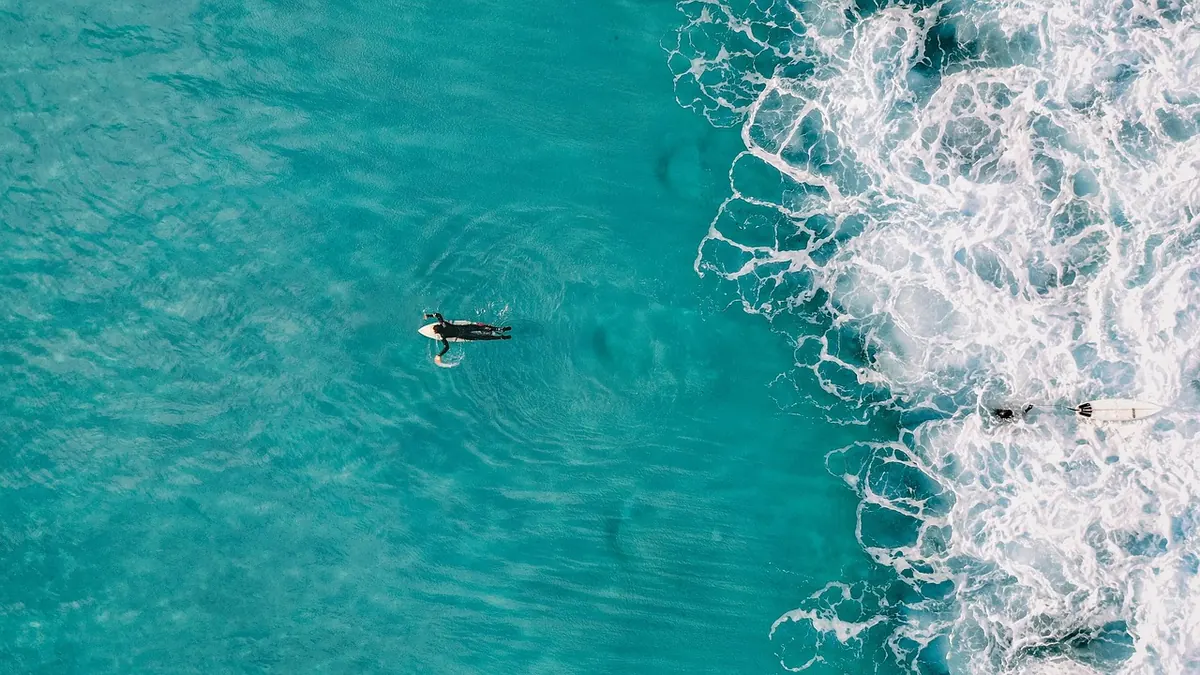
Rips aren't rare or dramatic. On many UK beach breaks they form most days: narrow, powerful flows of water heading offshore, usually cutting a channel between sandbanks or running beside a groyne or headland. Beginners either don't notice them or panic when they do, and both cost energy.
Signs to look for from the shore:
If you're new to the water, the safest choice is a lifeguarded beach, surfing between the red and yellow flags. If you do get caught, don't try to paddle straight back at the beach. You'll tire quickly and make no ground. Stay with your board, keep your breathing steady, and move across the current — parallel to the shore — until you feel it release. If you can't make progress, float, raise one arm and shout for the lifeguards rather than swimming against it.
Used deliberately, though, a rip is a free lift out the back. Paddle into it at an angle, aiming for the shoulder of the wave, and you'll save your arms for the ride itself.
The impact zone is where the waves are actually breaking, and it's the worst possible route out. Beginners paddle head-down into it and get rinsed by every wave in the set, arriving out the back exhausted before they've caught anything.
Stand on the beach and count the sets first. Most swells come in groups with a lull of a few minutes behind them, and that lull is your window. Look for a channel, often close to a rip or alongside a groyne, and use it. On shallow sandbanks you can often walk out to waist depth before you start paddling properly.
When a wave does come at you, keep hold of your board. Duck dive if you're on a shortboard, roll the board over if you're on a longboard or foamie, or push the nose down and take the wave on the head while gripping the rails. And think about the way back in before you go out: pick a landmark, keep half an eye behind you, and ride the whitewater in rather than paddling against it.
A borrowed shortboard is not a beginner's board. On something too small you'll spend the session lying on it and catching nothing, which teaches you very little. A foamie or a generous mid-length gives you the volume to paddle, catch waves and stand up, and you can still turn it once you've got the basics.
Your wetsuit matters just as much. Fit beats branding every time: a suit that's too loose flushes cold water on every duck dive, and one that's too tight restricts your shoulders. As autumn arrives, add boots, gloves and — depending on where you are and how cold it gets — a hood. Cold hands ruin pop-ups, and a cold body stops listening to you. Wade in gradually and splash your face and neck so your breathing settles before you commit. If you have a heart condition, asthma, epilepsy or ear problems, speak to your GP before taking up cold-water surfing.
Finally, be honest about the conditions. Knee-to-waist-high clean waves will teach you more in one session than a head-high closeout will in five. Surf within your fitness, and get out while you still have the energy to paddle in.
Good sessions are usually the result of good decisions made on dry sand. Before you get changed, run through this:
Progress in British surf comes from patience more than talent. Talk to locals, watch the sea at more tides than you surf it, and treat every session as practice in reading the beach — the waves will follow.
Photo: Pexels / Pixabay
Previous Post
Wetsuit Thickness Explained: How to Pick the Right mm for UK Waters
Next Post
Paddleboarding with Your Dog: A Step-by-Step Safety Guide